I'm super lazy and don't feel like doing write-ups for all my final books. Here's a list:
Books I read for Young Adult Lit (I wasn't gonna count books for school, but it seems other people are so whatever):
The Absolutely True Diary of a Part-Time Indian by Sherman Alexie
Slam by Nick Hornby
The Secret of Me: A Novel in Poems by Meg Kearney
Paranoid Park by Blake Nelson
The Curious Incident of the Dog in the Night-Time by Mark Haddon
Last Chance for First by Tom Hazuka
Lowboy by John Wray
Sophie's World by Jostein Gaarder
Monster by Walter Dean Myers
Final out-of-school reading:
My Rotten Life (Nathan Abercrombie, Accidental Zombie) by David Lubar
The Selected Poems of D.H. Lawrence
The Diaries of Adam and Eve by Mark Twain
Diary of a Wimpy Kid by Jeff Kinney
Sense and Sensibility by Jane Austen
2041: Twelve Short Stories About the Future edited by Jane Yolen
A Day No Pigs Would Die by Robert Newton Peck
The Wave by Todd Strasser
The Last Battle by C.S. Lewis
A Christmas Carol and Other Holiday Tales by Charles Dickens
Overall a good year for reading. I may start my own blog to track what I'm reading in 2010. We'll see!
Wednesday, December 30, 2009

Sunday, November 22, 2009
{Lindsay} 47-53
Still not much reading cause school is still kicking my butt. I did manage to get through the goal for the year, though a lot of them were fairly short near the end. I'm sure I'll be squeezing in a few more once I'm on winter break and have the two remaining weeks of the year free.
Before Halloween, I bought and read Alvin Schwartz's Scary Stories Boxed Set. If you don't know what that is, you were obviously deprived as a child.
Next was the first book in a new series called The Sisters Grimm. Book 1 is The Fairy Tale Detectives. Kids' lit of the fractured fairy tale variety, which is a double whammy of great in my book. I have the second and third books in the series, and I can't wait to read them.
After that I ventured back to Narnia. I read The Lion, the Witch, and the Wardrobe, Prince Caspian, The Voyage of the Dawn Treader, and The Silver Chair. These four form the most cohesive narrative out of all the books, so reading them and skipping the ones that don't quite fit made for a much better reading experience this time through them. I still have The Last Battle to get through, then two other ones in the series that don't go into that overall story arc. I did some research on each of the books as I was reading them and tried to get a sense of what Lewis was trying to accomplish with each one. I think that gave me a much better appreciation of the books than I previously had, and I'd like to do more research into Lewis and Narnia at some point.
Finally for this batch was Aesop's Fables. I'd been meaning to read these forever but never have until now. I don't really have an opinion on them either way, but I feel like they're literary classics that deserve at least one read through. I feel like they might also be a useful teaching tool for vocabulary, grammar, and introductory analytical activities, so maybe someday I'll get to use them in the classroom.
Not too many for this time, but I guess I'm officially done. I'll still be reading till the end of the year, though, so I'm sure you'll be hearing from me at least once more.
Before Halloween, I bought and read Alvin Schwartz's Scary Stories Boxed Set. If you don't know what that is, you were obviously deprived as a child.
Next was the first book in a new series called The Sisters Grimm. Book 1 is The Fairy Tale Detectives. Kids' lit of the fractured fairy tale variety, which is a double whammy of great in my book. I have the second and third books in the series, and I can't wait to read them.
After that I ventured back to Narnia. I read The Lion, the Witch, and the Wardrobe, Prince Caspian, The Voyage of the Dawn Treader, and The Silver Chair. These four form the most cohesive narrative out of all the books, so reading them and skipping the ones that don't quite fit made for a much better reading experience this time through them. I still have The Last Battle to get through, then two other ones in the series that don't go into that overall story arc. I did some research on each of the books as I was reading them and tried to get a sense of what Lewis was trying to accomplish with each one. I think that gave me a much better appreciation of the books than I previously had, and I'd like to do more research into Lewis and Narnia at some point.
Finally for this batch was Aesop's Fables. I'd been meaning to read these forever but never have until now. I don't really have an opinion on them either way, but I feel like they're literary classics that deserve at least one read through. I feel like they might also be a useful teaching tool for vocabulary, grammar, and introductory analytical activities, so maybe someday I'll get to use them in the classroom.
Not too many for this time, but I guess I'm officially done. I'll still be reading till the end of the year, though, so I'm sure you'll be hearing from me at least once more.
Sunday, October 11, 2009
Books 31-39
So, I have several more books to add to the list. Here we go!
31. Haruki Murakami - The Wind Up Bird Chronicle
32. Hakim Bey - Immediatism
33. Hakim Bey - Temporary Autonomous Zones
34. Jeff Smith - 'Bone' books 4 and 5
35. 'Swamp Thing' book 3
36. 'Swamp Thing' book 4
37. 'Swamp Thing' book 5
38. Sophocles - Oedipus Rex
39. Sophocles - Antigone
So, the Sophocles plays and the two Hakim Bey books are both re-reads for me. In the Greek tragedy case, it was for my final English class before I graduate, which is thankfully a better class than that shit I took over the summer. Hakim Bey is just a great political author who writes about anarchist and autonomous concepts in an interesting, albeit crazy, way. He's sort of like the situationists if they believed in magic and middle-eastern spiritualism, or something along those lines. I don't know how to describe it any more fairly, so I apologize. If it's a subject you're interested in, you should just give these two books a read. They're both incredibly short and filled from beginning to end with enthralling writing.
I read Wind Up Bird Chronicle knowing that it is one of Murakami's more famous books, and also that it delves more into his magical realism territories than my previous read of his did. However, I loved Norwegian Wood, and I was hopeful that the writing in this book would be as good as that, even if the subject matter changed. I'm glad to say that this book was equally as enjoyable, though much longer, and it was something I was actually excited to read.
Bone is a 9 book graphic novel series that was originally published as comics in the early 90s. I've been reading it off and on for a while now, but I'm trying to get around to finishing it this semester, along with Swamp Thing. Swamp Thing also has 9 compiled books of older comics, I believe, though Alan Moore was only on board for enough comics to fill the first 6 books. Still, the writing, art, and story in general is phenomenal, and it's another series I'm excited to finish. Books 3-5 have some more great political allegories, and also delve into more supernatural realms, and craft Swamp Thing into a more super-powered super hero. Read it, it rules.
31. Haruki Murakami - The Wind Up Bird Chronicle
32. Hakim Bey - Immediatism
33. Hakim Bey - Temporary Autonomous Zones
34. Jeff Smith - 'Bone' books 4 and 5
35. 'Swamp Thing' book 3
36. 'Swamp Thing' book 4
37. 'Swamp Thing' book 5
38. Sophocles - Oedipus Rex
39. Sophocles - Antigone
So, the Sophocles plays and the two Hakim Bey books are both re-reads for me. In the Greek tragedy case, it was for my final English class before I graduate, which is thankfully a better class than that shit I took over the summer. Hakim Bey is just a great political author who writes about anarchist and autonomous concepts in an interesting, albeit crazy, way. He's sort of like the situationists if they believed in magic and middle-eastern spiritualism, or something along those lines. I don't know how to describe it any more fairly, so I apologize. If it's a subject you're interested in, you should just give these two books a read. They're both incredibly short and filled from beginning to end with enthralling writing.
I read Wind Up Bird Chronicle knowing that it is one of Murakami's more famous books, and also that it delves more into his magical realism territories than my previous read of his did. However, I loved Norwegian Wood, and I was hopeful that the writing in this book would be as good as that, even if the subject matter changed. I'm glad to say that this book was equally as enjoyable, though much longer, and it was something I was actually excited to read.
Bone is a 9 book graphic novel series that was originally published as comics in the early 90s. I've been reading it off and on for a while now, but I'm trying to get around to finishing it this semester, along with Swamp Thing. Swamp Thing also has 9 compiled books of older comics, I believe, though Alan Moore was only on board for enough comics to fill the first 6 books. Still, the writing, art, and story in general is phenomenal, and it's another series I'm excited to finish. Books 3-5 have some more great political allegories, and also delve into more supernatural realms, and craft Swamp Thing into a more super-powered super hero. Read it, it rules.
Monday, September 28, 2009
{Lindsay} 41-46
School starting = reading slowing. No pictures for this post cause I don't have time!
First for this batch was The Feminine Mystique by Betty Friedan, pretty much a classic of feminist literature. I was surprised because this book is based on a series of interviews with women Betty did in the middle part of the 20th century, rather than the typical personal experience approach that most of the feminist lit I've been reading takes. Basically, she examines women's fulfillment in housewife roles, how that feeling of fulfillment changed from generation to generation, and explores how marketing and outside (i.e. men's) definition of the role of women in the household made women believe that the role of the housewife is and should be fulfilling for all women. It was written in the 60s, so obviously it's a bit dated, but I definitely found it an interesting read.
Next was The Egypt Game by Zilpha Keatley Snyder, a book my dad used to read to me as a kid. I'm taking a class on Young Adult Literature this semester, so my pleasure reading is definitely going to involve a lot more of that and kid's lit. I really didn't remember many of the details in the book, but while reading it I definitely felt a sense of calming familiarity. I don't know if that was the book itself, or the whole idea of playing make-believe that drives the plot. Either way, it definitely brought me back to someplace from my childhood, so I'm glad I decided to read it again after all these years.
Recently I read Craig Ferguson's memoir, American on Purpose. I'm a big fan of Craig in general, and I loved his novel, so I was pretty psyched for this to come out. I was slightly let down, though, because the book kind of rambles along, and he focuses on really minute details where it might have been better to just paint a broader picture. Regardless, as a fan, I enjoyed some of the anecdotes and occasional laugh-out-loud moments of the book.
Yesterday I finished Phillip Pullman's His Dark Materials trilogy for the second time. I debated counting it, since it's technically for class, but I'm reading it for my final paper, and I got to choose what I wanted to write my final paper on, and all the other choices didn't include reading any novels, so I'm gonna go ahead and give myself some extra reading credit for this one. Basically, if you haven't read this trilogy (The Golden Compass, The Subtle Knife, The Amber Spyglass), you are missing out something fierce on a fascinating take on religion, growing up, and Original Sin. I feel like saying anything more will completely fail to do these books justice, so do yourselves a favor and read them. Read Paradise Lost while you're at it, as well, since the trilogy is based primarily off that.
I've currently got a few other books in rotation, but who knows when I'll have time to get all the way through them. Only technically need six more, though, so I'm not really in any rush!
First for this batch was The Feminine Mystique by Betty Friedan, pretty much a classic of feminist literature. I was surprised because this book is based on a series of interviews with women Betty did in the middle part of the 20th century, rather than the typical personal experience approach that most of the feminist lit I've been reading takes. Basically, she examines women's fulfillment in housewife roles, how that feeling of fulfillment changed from generation to generation, and explores how marketing and outside (i.e. men's) definition of the role of women in the household made women believe that the role of the housewife is and should be fulfilling for all women. It was written in the 60s, so obviously it's a bit dated, but I definitely found it an interesting read.
Next was The Egypt Game by Zilpha Keatley Snyder, a book my dad used to read to me as a kid. I'm taking a class on Young Adult Literature this semester, so my pleasure reading is definitely going to involve a lot more of that and kid's lit. I really didn't remember many of the details in the book, but while reading it I definitely felt a sense of calming familiarity. I don't know if that was the book itself, or the whole idea of playing make-believe that drives the plot. Either way, it definitely brought me back to someplace from my childhood, so I'm glad I decided to read it again after all these years.
Recently I read Craig Ferguson's memoir, American on Purpose. I'm a big fan of Craig in general, and I loved his novel, so I was pretty psyched for this to come out. I was slightly let down, though, because the book kind of rambles along, and he focuses on really minute details where it might have been better to just paint a broader picture. Regardless, as a fan, I enjoyed some of the anecdotes and occasional laugh-out-loud moments of the book.
Yesterday I finished Phillip Pullman's His Dark Materials trilogy for the second time. I debated counting it, since it's technically for class, but I'm reading it for my final paper, and I got to choose what I wanted to write my final paper on, and all the other choices didn't include reading any novels, so I'm gonna go ahead and give myself some extra reading credit for this one. Basically, if you haven't read this trilogy (The Golden Compass, The Subtle Knife, The Amber Spyglass), you are missing out something fierce on a fascinating take on religion, growing up, and Original Sin. I feel like saying anything more will completely fail to do these books justice, so do yourselves a favor and read them. Read Paradise Lost while you're at it, as well, since the trilogy is based primarily off that.
I've currently got a few other books in rotation, but who knows when I'll have time to get all the way through them. Only technically need six more, though, so I'm not really in any rush!
Wednesday, September 2, 2009
Books 28-30
 Well the last three books have been a bit weird, or maybe not that weird at all. I finished Love In The Time Of Cholera, and Swamp Thing books 1 and 2.
Love In The Time Of Cholera was a wonderful story, but there's some confusing elements in describing reading it, this is a kind of hard response to write. The way it portrays love is simultaneously wonderful and depressing. The character toils away for years loving the same person with all of their heart, and everything about the love makes you feel hopeful and like dying.
To be fair, I have been rating some graphic
 novels as full books, while as others I have been counting as batches of books. In this case, Alan Moore's writing in his run on Swamp Thing is a bit heavier than Jeff Smith's writing in Bone. This is not to say anything poorly of the Bone stories, or any other comics I read that I counted as less than a full book, it just takes me roughly the same amount of time to read three Walking Dead books as it does to read anything else.
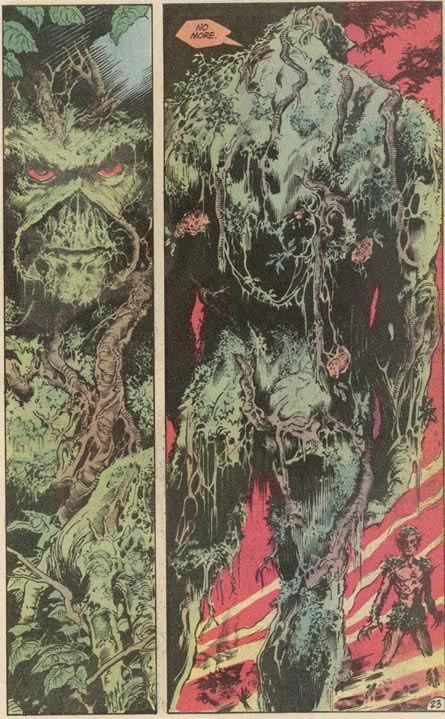
The first book of Swamp Thing is pretty classic as far as Swamp Thing stories go, it reestablishes the character after a long hiatus from publication, and still manages to introduce new characters and concepts, and exciting events. I am giving this book a shorter review to focus on the second one, but that's not to speak poorly of book one, clearly it gripped me enough to go out and buy and read the second book. Book one's events are familiar from the outset, even though I never read the original 17 issues from the 70s that technically precede it. With the exception of one event in the last chapter, everything in the story felt familiar and welcoming, or as welcoming as a horror/sci-fi comic book can feel, I suppose.
 However, it's really in book two of Alan Moore's run that things hit their stride. The bulk of the stories within take place on a literal journey through Moore's interpretations of Purgatory, Heaven, and Hell, complete with different spiritual guides in each realm to aid Swamp Thing in his search of his loved one. These parts of the stories are where it earns its reputation as a horror story and a story for mature readers. Shit hits the fan pretty hard early on in the story and it doesn't really let up until the last chapter. Incidentally, in addition to going on a journey through the afterlife, the second book finds time to go over putting some finality on older storylines, establishing a deeper new history for Swamp Thing, and going on a hallucinogenic freak out love-song/love-scene. The third to last chapter is a tribute to an older comic, Pogo Possum, that is brilliant, sad, touching, and probably the most misanthropic thing DC ever printed. If you're aware of Pogo Possum (which you should be, really) the references are great, and clearly written with care by a devoted fan of those stories, who is not just giving adorations, but looking to leave his own mark on what he considers one of the greats. However, what makes this tribute even more wonderful, is even if you went into it with absolutely no knowledge of the comic he is referencing, the horror and sadness are still just as real, and the political points still strike just as harshly. As obvious as the surprise in this chapter is in retrospect, when it happened in the comic, I was genuinely shocked and dismayed. The emotional depth in these comics is perfect, and the great art only helps to make this more striking. This is easily my most recommended comic of the year, including all the Bone stories, including Maggots, Walking Dead, Capacity, and some of the shorter fun things I've read to fill the time.
Really, look at this shit, it's amazing:
Tuesday, August 25, 2009
Books 18 - 24
The last seven books I've read have been all seven Harry Potter books. I feel it's not necessary to list the titles! 1-6 were rereads, but 7 was basically the first time I've read through it, because I only read about 100 pages of it when it came out and had to stop to finish up my summer reading. I sort of dreaded reading it, and spread it out over like 4 days, when I could have easily finished it in one or two. I'm feeling slightly upset that I've finished them all for good, but ah well time to move onto other things!
I do suppose it was good for me to reread all of them as they've helped my book count tremendously, but when I start school in less than a week, I'll go back to reading two books a month, oof. Short entry, whatever!
I do suppose it was good for me to reread all of them as they've helped my book count tremendously, but when I start school in less than a week, I'll go back to reading two books a month, oof. Short entry, whatever!
Friday, August 21, 2009
{Lindsay} 31-40
Moving right along! I love reading binges.
I read some more S hakespeare, this time in the form of Titus Andronicus. Apparently this is Shakespeare's critically worst play, but I enjoyed it. Pretty violent plot driven by vengeance, which I tend to love, so purely from an entertainment angle, I was satisfied with it. Unfortunately I really need the assistance of SparkNotes to help me get past an appreciation of the Bard based purely on entertainment, but whatever. Thanks, Lit degree! Here's hoping I don't fail miserably as an English teacher...
Next were a couple VERY different feminist works. One was called Cunt: A Declaration of Independence, by Inga Muscio. I'll admit, I picked up this book solely because of the title, but what this book seemed to be about was what made me buy it. What I THOUGHT I was gonna read was a long, detailed history of the word "cunt" and how it's meaning and connotations have changed over the course of its history. This was how the book seemed to be marketed, since that was mostly what the little back-cover blurb focused on. Since this is one of my favorite words in any language, and since I'm a whore for language in general, obviously I thought this was going to be a great read. Unfortunately, the marketing and reality of the content of the book didn't quite pair up. Even after reading it, I'm not sure I could give an adequate description of the overall point this author is trying to make. The word origin section is the shortest section in the book, and it's completely lacking in concrete details. The rest of the book lacks clear flow, cohesion, and and has the worst editing I have ever seen in a widely-published work, with the most awkward line breaks I have ever seen in anything. This woman is a SUPER feminist, who takes the stance that men aren't needed for anything and that women should just let their period blood flow down their legs every month. I also had a hard time
  reconciling her stance against birth control with her detailed descriptions of how horrible two of her three abortions were. I don't necessarily fault her as a person for that, but it's not quite the same path of girl-power I myself tread. Overall I found this book completely alienating, both in content and presentation. I enjoyed Jessica Valenti's Full-Frontal Feminism a lot more. She's a bit younger, appreciates the presence of men in her life, and overall just seems to take a much more balanced view on the whole feminism thing. I really enjoy her writing style, and find myself agreeing with a lot of what she has to say.
Next was No Plot? No Problem! by Chris Baty. I'd been meaning to get this book for awhil e, but never felt like paying $15 for it (it's a fairly small volume), but luckily I found it at a book discount warehouse for a third of the retail price. Baty is the creator of National Novel Writing Month (NaNoWriMo), which takes place every November. Basically you have a month to write a super shitty first draft of a 50,000 word novel. This book is full of tips and support to get through the month and keep your ideas and word count going. I've tried to participate a few years, but never end up getting very far. I'm hoping to finally bite the bullet this year and actually let myself write horrible prose simply for the sake of doing it.
After that was some children's/young adult fiction. First was Pippi Longstocking, which I almost feel bad for counting because it's SO short. That's okay, though. I'll just have to read a 53rd book to make up for it. Despite it being somewhat of a classic, I'd never read it before. I did, however, enjoy the movie when I was little. I thought it was okay. I don't know that I'd care to read it again any time soon, but I guess it was enjoyable.
I continued with something a bit longer: A Wrinkle In Time by Madeleine L'Engle. This is another classic I'd never read until now, and I definitely enjoyed this one more than Pippi. I really had no idea what to expect going into it, and my first read through of it was a bit frustrating because I had no idea what sort of characters and situations were about to be encountered along the way. Interestingly, at the same time I felt the very end chapters lacked any real tension in terms of plot, but maybe that doesn't necessarily hold true for younger readers. Either way, a good read, and I might be interested to read the rest of the books in the series.
Next was The Tale of Despereaux by Kate Dicamillo, which I think is my favorite of this bunch. The plot constr uction of this book is great, because it focuses mostly around character introductions. In the course of these introductions, a little bit of the plot is set in motion, but before it goes too far, the next character gets introduced, and then the plot involving that character ends up tying in with the plot bits of the character prior. This makes you really want to keep reading. The writing itself is really great, and the book is full of universal themes and truths, so it's also very emotionally fulfilling.
Finally, an omnibus of three Michael Crichton novels, The And romeda Strain, The Terminal Man, and The Great Train Robbery. I'd been trying to get through this collection for weeks, so I'm glad to finally just have it out of the way. I've come to realize that I really don't even care about plot when it comes to Crichton, because all the science and technology and random facts he throws into his stories are so freaking interesting. I'm fairly certain I would be entertained reading anything by him.
I read some more S
 hakespeare, this time in the form of Titus Andronicus. Apparently this is Shakespeare's critically worst play, but I enjoyed it. Pretty violent plot driven by vengeance, which I tend to love, so purely from an entertainment angle, I was satisfied with it. Unfortunately I really need the assistance of SparkNotes to help me get past an appreciation of the Bard based purely on entertainment, but whatever. Thanks, Lit degree! Here's hoping I don't fail miserably as an English teacher...
Next were a couple VERY different feminist works. One was called Cunt: A Declaration of Independence, by Inga Muscio. I'll admit, I picked up this book solely because of the title, but what this book seemed to be about was what made
 me buy it. What I THOUGHT I was gonna read was a long, detailed history of the word "cunt" and how it's meaning and connotations have changed over the course of its history. This was how the book seemed to be marketed, since that was mostly what the little back-cover blurb focused on. Since this is one of my favorite words in any language, and since I'm a whore for language in general, obviously I thought this was going to be a great read. Unfortunately, the marketing and reality of the content of the book didn't quite pair up. Even after reading it, I'm not sure I could give an adequate description of the overall point this author is trying to make. The word origin section is the shortest section in the book, and it's completely lacking in concrete details. The rest of the book lacks clear flow, cohesion, and and has the worst editing I have ever seen in a widely-published work, with the most awkward line breaks I have ever seen in anything. This woman is a SUPER feminist, who takes the stance that men aren't needed for anything and that women should just let their period blood flow down their legs every month. I also had a hard time
  reconciling her stance against birth control with her detailed descriptions of how horrible two of her three abortions were. I don't necessarily fault her as a person for that, but it's not quite the same path of girl-power I myself tread. Overall I found this book completely alienating, both in content and presentation. I enjoyed Jessica Valenti's Full-Frontal Feminism a lot more. She's a bit younger, appreciates the presence of men in her life, and overall just seems to take a much more balanced view on the whole feminism thing. I really enjoy her writing style, and find myself agreeing with a lot of what she has to say.
Next was No Plot? No Problem! by Chris Baty. I'd been meaning to get this book for awhil
 e, but never felt like paying $15 for it (it's a fairly small volume), but luckily I found it at a book discount warehouse for a third of the retail price. Baty is the creator of National Novel Writing Month (NaNoWriMo), which takes place every November. Basically you have a month to write a super shitty first draft of a 50,000 word novel. This book is full of tips and support to get through the month and keep your ideas and word count going. I've tried to participate a few years, but never end up getting very far. I'm hoping to finally bite the bullet this year and actually let myself write horrible prose simply for the sake of doing it.
After that was some children's/young adult fiction. First was Pippi Longstocking,
 which I almost feel bad for counting because it's SO short. That's okay, though. I'll just have to read a 53rd book to make up for it. Despite it being somewhat of a classic, I'd never read it before. I did, however, enjoy the movie when I was little. I thought it was okay. I don't know that I'd care to read it again any time soon, but I guess it was enjoyable.
I continued with something a bit longer: A Wrinkle In Time by
 Madeleine L'Engle. This is another classic I'd never read until now, and I definitely enjoyed this one more than Pippi. I really had no idea what to expect going into it, and my first read through of it was a bit frustrating because I had no idea what sort of characters and situations were about to be encountered along the way. Interestingly, at the same time I felt the very end chapters lacked any real tension in terms of plot, but maybe that doesn't necessarily hold true for younger readers. Either way, a good read, and I might be interested to read the rest of the books in the series.
Next was The Tale of Despereaux by Kate Dicamillo, which I think is my favorite of this bunch. The plot constr
 uction of this book is great, because it focuses mostly around character introductions. In the course of these introductions, a little bit of the plot is set in motion, but before it goes too far, the next character gets introduced, and then the plot involving that character ends up tying in with the plot bits of the character prior. This makes you really want to keep reading. The writing itself is really great, and the book is full of universal themes and truths, so it's also very emotionally fulfilling.
Finally, an omnibus of three Michael Crichton novels, The And
 romeda Strain, The Terminal Man, and The Great Train Robbery. I'd been trying to get through this collection for weeks, so I'm glad to finally just have it out of the way. I've come to realize that I really don't even care about plot when it comes to Crichton, because all the science and technology and random facts he throws into his stories are so freaking interesting. I'm fairly certain I would be entertained reading anything by him.
Sunday, August 9, 2009
(Fritz) Books 22-27
I finished a few books in the last week or two since my last post. Obviously two cross country flights and vacation in general give you plenty of time to just hang out and read. I actually finished books 22-27, some of which I'll be reviewing after the list:
22. Walking Dead 1-3
23. Walking Dead 3-6
24. Jurassic Park - Michael Crichton
25. No One Belongs Here More Than You - Miranda July
26. Norwegian Wood - Haruki Murakami
27. Capacity - Theo Ellsworth
 The first book I finished was Michael Crichton's Jurassic Park. I suppose this book is sort of old news to most people, especially because of the movie coming out 17 years ago and such, but it was a favorite film of mine, and I think it's definitely worth reading the book. There is a greater depth to the details, as well as a large change to many [big] plot points. Characters exist in the novel that aren't even in the movie, characters who don't die in one medium do die in the other, etc. etc. The one nice thing about this story, is that as science fiction, it displays a pretty good grasp of real science and a realm of believable pseudoscience that never really breaks you away from the story. The novel always manages to keep an element of suspense and the ending actually did a great job at surprising me. I guess it would be right to end this review by saying the novel was memorable and thoroughly enjoyable.
The next book in the last few weeks was "No one belongs here more than you." which is a compilation of short stories by Miranda July (of course you could probably discern that from the picture). There's about 16 short stories in here, and I don't think I could do any one of them justice trying to explain it. I guess this may seem like a negative criticism, but every story in here is firmly a Miranda July story. I'm told by two friends that her early writing was very different than her stuff after the film "Me and You and Everyone We Know" and that a lot of her old fans were alienated by her later works. I couldn't really find anything to substantiate this rumor online really, but apparently she used to be in with Kill Rock Stars records, and is good friends with a member of Le Tigre, so there you go. Anyway, what I meant by all these stories being obvious Miranda July stories, is if you've read her other famous stories, or seen any of her films, the stories in here are clearly written by the same person. There's this constant sense of alienation, awkwardness, social anxiety, or whatever word or words would fit this better. You feel the desperation of trying to work things out in a mundane and lonely world. (That's deep, man). There is a huge element of sexuality to these stories as well, and a lot of focus on illicit love. Somehow though, you never really feel like you should be condemning these characters, though, you sort of just understand what things would lead them to these places. And this is not to say that all the stories are perverted or depressing or any of that, far from it. Many of these stories contain moments of extreme beauty and insight that make you really consider how you approach your world, which is obviously one of the most powerful things a story can do. I would definitely recommend checking out at least a few of the stories in here, "This Person" and "I Kiss A Door" particularly stand out in my memory as being worthwhile stories.
Even more recently still, I finished Haruki Murakami's Norwegian Wood. Murakami is (I guess) generally known, for a stylistic combination of Magical Realism or supernatural themes, with Pop. I could probably go on for a while about the Pop themes in this, and then couple it with Pop themes in other shit, I'll avoid the travesty as that's what it would be. The short story is that this book was seen as a radical departure by many of his long term fans, as, quite simply, nothing particularly supernatural ever happens in this book. The thing is, that's okay though. This is sort of a love story, and that's okay too. However, due to Murakami's wonderfully detailed writing, it goes beyond just being a love story, it almost becomes an adventure. We see wonderfully complex characters growing, learning, developing, and changing over the course of the story in great ways. There are great surprises, and even some of the things that you expect to occur, still come across as shocking when they happen. The ending is the only part of the book I felt even a little let down by, and that's solely because of the openness of it. I guess, if your only complaint about a book is that the author let you have your own interpretation the work, then the author did a fine job? Coincidentally (I don't think this counts as ironically), this book, while being a departure from his known style, is what 'launched' Murakami into stardom, much to his chagrin.
 Capacity by Theo Ellsworth is a graphic novel of beyond-surreal narratives. The introduction to the book deals with you (yes, literally you, the reader) traversing through a dream world, where you are confronted by different bizarre creatures who help you to eventually reach the actual author himself. The rest of the book could simply just be a compilation of his smaller zines of comics he's released over the past five years, but given the grandiose beginnings, he's not content to do just that, and he strings the different pieces from his past together in a sort of adventure theater that almost becomes challenging to figure out what's "actually happening" to you and what's just occurring in front of your eyes, until the very end when he pulls it back together with a wonderful ending. This of course says nothing of the narratives which are compiled within, which are even more enchanting or enchanted, in every sense of those two words. There is a tremendous amount of self doubt in the artist-insert-narrator's voice, but it is never cliché or trite, but instead it's endearing. You get a sense for the literal aspects of his life, as they're told in the most mundane of detail and the most exaggerated of magical realism, sometimes at the same time. (Does this go beyond magical realism? Probably, you should judge for yourself). And of course, this says nothing of the art, which is just breath-taking. I was constantly made jealous of Ellsworth's talent and dedication to his craft (which he of course talks about at points, along with everything else in his life and your life and the bizarre dreamworlds we all often inhabit). If you're one of those people who doesn't see graphic novels or comics or whatever as "art" or "literature" then this book could probably change your mind. And if it doesn't, then you're some kind of troglodyte. Though, be prepared, this is a heavy read, I'd say far heavier than most books of this length (334 pages). I picked up a newer zine of this guy's work while I was in Los Angeles, which I'll be reading soon, somewhere in between my next two books. I'll let you know how it is (though at 18 pages, I won't be counting it as a full book, obviously).
22. Walking Dead 1-3
23. Walking Dead 3-6
24. Jurassic Park - Michael Crichton
25. No One Belongs Here More Than You - Miranda July
26. Norwegian Wood - Haruki Murakami
27. Capacity - Theo Ellsworth
The first book I finished was Michael Crichton's Jurassic Park. I suppose this book is sort of old news to most people, especially because of the movie coming out 17 years ago and such, but it was a favorite film of mine, and I think it's definitely worth reading the book. There is a greater depth to the details, as well as a large change to many [big] plot points. Characters exist in the novel that aren't even in the movie, characters who don't die in one medium do die in the other, etc. etc. The one nice thing about this story, is that as science fiction, it displays a pretty good grasp of real science and a realm of believable pseudoscience that never really breaks you away from the story. The novel always manages to keep an element of suspense and the ending actually did a great job at surprising me. I guess it would be right to end this review by saying the novel was memorable and thoroughly enjoyable.The next book in the last few weeks was "No one belongs here more than you." which is a
compilation of short stories by Miranda July (of course you could probably discern that from the picture). There's about 16 short stories in here, and I don't think I could do any one of them justice trying to explain it. I guess this may seem like a negative criticism, but every story in here is firmly a Miranda July story. I'm told by two friends that her early writing was very different than her stuff after the film "Me and You and Everyone We Know" and that a lot of her old fans were alienated by her later works. I couldn't really find anything to substantiate this rumor online really, but apparently she used to be in with Kill Rock Stars records, and is good friends with a member of Le Tigre, so there you go. Anyway, what I meant by all these stories being obvious Miranda July stories, is if you've read her other famous stories, or seen any of her films, the stories in here are clearly written by the same person. There's this constant sense of alienation, awkwardness, social anxiety, or whatever word or words would fit this better. You feel the desperation of trying to work things out in a mundane and lonely world. (That's deep, man). There is a huge element of sexuality to these stories as well, and a lot of focus on illicit love. Somehow though, you never really feel like you should be condemning these characters, though, you sort of just understand what things would lead them to these places. And this is not to say that all the stories are perverted or depressing or any of that, far from it. Many of these stories contain moments of extreme beauty and insight that make you really consider how you approach your world, which is obviously one of the most powerful things a story can do. I would definitely recommend checking out at least a few of the stories in here, "This Person" and "I Kiss A Door" particularly stand out in my memory as being worthwhile stories.Even more recently still, I finished Haruki Murakami's Norwegian Wood.
Murakami is (I guess) generally known, for a stylistic combination of Magical Realism or supernatural themes, with Pop. I could probably go on for a while about the Pop themes in this, and then couple it with Pop themes in other shit, I'll avoid the travesty as that's what it would be. The short story is that this book was seen as a radical departure by many of his long term fans, as, quite simply, nothing particularly supernatural ever happens in this book. The thing is, that's okay though. This is sort of a love story, and that's okay too. However, due to Murakami's wonderfully detailed writing, it goes beyond just being a love story, it almost becomes an adventure. We see wonderfully complex characters growing, learning, developing, and changing over the course of the story in great ways. There are great surprises, and even some of the things that you expect to occur, still come across as shocking when they happen. The ending is the only part of the book I felt even a little let down by, and that's solely because of the openness of it. I guess, if your only complaint about a book is that the author let you have your own interpretation the work, then the author did a fine job? Coincidentally (I don't think this counts as ironically), this book, while being a departure from his known style, is what 'launched' Murakami into stardom, much to his chagrin.Capacity by Theo Ellsworth is a graphic novel of beyond-surreal narratives. The introduction to the book deals with you (yes, literally you, the reader) traversing through a dream world, where you are confronted by different bizarre creatures who help you to eventually reach the actual author himself. The rest of the book could simply just be a compilation of his smaller zines of comics he's released over the past five years, but given the grandiose beginnings, he's not content to do just that, and he strings the different pieces from his past together in a sort of adventure theater that almost becomes challenging to figure out what's "actually happening" to you and what's just occurring in front of your eyes, until the very end when he pulls it back together with a wonderful ending. This of course says nothing of the narratives which are compiled within, which are even more enchanting or enchanted, in every sense of those two words. There is a tremendous amount of self doubt in the artist-insert-narrator's voice, but it is never cliché or trite, but instead it's endearing. You get a sense for the literal aspects of his life, as they're told in the most mundane of detail and the most exaggerated of magical realism, sometimes at the same time. (Does this go beyond magical realism? Probably, you should judge for yourself). And of course, this says nothing of the art, which is just breath-taking. I was constantly made jealous of Ellsworth's talent and dedication to his craft (which he of course talks about at points, along with everything else in his life and your life and the bizarre dreamworlds we all often inhabit). If you're one of those people who doesn't see graphic novels or comics or whatever as "art" or "literature" then this book could probably change your mind. And if it doesn't, then you're some kind of troglodyte. Though, be prepared, this is a heavy read, I'd say far heavier than most books of this length (334 pages). I picked up a newer zine of this guy's work while I was in Los Angeles, which I'll be reading soon, somewhere in between my next two books. I'll let you know how it is (though at 18 pages, I won't be counting it as a full book, obviously).
Saturday, August 1, 2009
{Lindsay} 20-30
My latest reading spree was quite a success, and I have plenty more lined up that I wanna get through before school starts again. I'm hoping to get a little bit ahead in the next month, because I'm sure I'm going to be plenty busy between class and two jobs and won't have much free time for reading. Boooo!
Anyway, I started the latest batch with Jon Stewart's Naked Pictures of Famous People. I was expecting t o really enjoy it, because I've always been amused by The Daily Show when I've watched it, and thought his stand-up was really great when I saw him a few years ago at the Bushnell. However, this book is kind of a snoozefest, and I was glad it was short and didn't take me long to get through. I honestly don't think I laughed once reading it.
Next was The End of Overeating by David Kessler. I borrowed it fro m my dad and thought it was pretty interesting. It goes into how food in the U.S. is developed and marketed to condition us crave more of it by using a lot of fat, sugar, and salt. He takes a psychological approach to the country's obesity problems, and focuses on the food industry as driving our psychological needs for unhealthy foods.
After that I ventured again toward some childhood favorites. First was Roald Da hl, with The Witches and Charlie
and the Chocolate Factory. I didn't actually read Charlie when I was younger, but Witches was always a favorite, and they both made for nice quick reads.
Next was a book called Ella Minnow Pea by Mark Dunn. I first read this book in college as part of a campus book-club type thing, but hadn't read it again until now. If you like language, this is a really fun book to check out. The premise of the book is as follows (courtesy of Amazon.com):
"Ella Minnow Pea is a girl living happily on the fictional island of Nollop off the coast of South Carolina. Nollop was named after Nevin Nollop, aut hor of the immortal pangram,* “The quick brown fox jumps over the lazy dog.” Now Ella finds herself acting to save her friends, family, and fellow citizens from the encroaching totalitarianism of the island’s Council, which has banned the use of certain letters of the alphabet as they fall from a memorial statue of Nevin Nollop. As the letters progressively drop from the statue they also disappear from the novel. The result is both a hilarious and moving story of one girl’s fight for freedom of expression, as well as a linguistic tour de force sure to delight word lovers everywhere.
*pangram: a sentence or phrase that includes all the letters of the alphabet"
Next was The House With a Clock In Its Walls by John Bellairs, who was one of my favorite authors when I was younger. I also read The Figure In the Shadows and The Letter, the Witch, and the Ring, which are both sequels to House and follow the same characters. They're sort of gothic novels for kids, and involve magic and evil things that need conquering, but the characters and settings are set in reality. Hopefully I'll get to re-read the other Bellairs books I have soon.
I decided to venture back into the world of Shakespeare and see if I like it any better, so I decided to re-read "Romeo and Juliet," which I haven't looked at since 9th grade. It turns out old William's not so bad after all. I guess my brain just needed a reeeeeeally long time to get comfortable with the language, though I think "R&J" is one of his easier plays (thus it being taught in high school, even though in high school I really didn't get it). Still, I haven't really appreciated him until now, despite taking a whole class on him in college. I will definitely be reading more of his plays soon. Good thing I have a giant anthology of everything he ever wrote.
My decision to read more Shakespeare stemmed from my reading The Merry Adventures of Robin Hood by Howard Pyle, which I picked up on a whim while I was at Borders one day. I got the "Borders Classics" edition, so it's a nice hardcover with faux-gilted page edges and one of those attached fabric bookmark things (unfortunately I couldn't find an image of it). It was originally published in 1883, but Pyle, and American author who also illustrated the book, used late medieval/really early modern English to write the book. It's not quite as tricky as the language Shakespeare used, but it definitely requires some slow reading.
Finally, just today I finished reading Metaphors We Live By by George Lakoff and Mark Johnson. I wanted to read it because I had heard it mentioned in a couple of my more linguistic-y classes in my grad program and wanted to see what all the fuss was about. I had a hard time getting through it, but I can't figure out why. It's definitely more of an academic-oriented book, but the language of the book itself isn't that difficult to weed through, nor are the concepts. I think it just has so much packed in that I had a hard time figuring out what the point of it was or really remembering anything from it for a significant amount of time. I'm sure if I read it one or two more times, I would be able to appreciate it more, or read it for a class and have discussions about it. It really just talks about ALL language as being very metaphorical, as opposed to just literary or poetic language, and it gives a ton of examples and breaks things down into categories of different types of metaphors. I guess I got the book in hopes that I could incorporate it into my teaching someday/how, but after reading it once, I'm not so sure. Oh well.
I'm not too sure what I'll be reading next, but I still have quite a stack of things to keep me goin for the rest of the year!
Anyway, I started the latest batch with Jon Stewart's Naked Pictures of Famous People. I was expecting t
 o really enjoy it, because I've always been amused by The Daily Show when I've watched it, and thought his stand-up was really great when I saw him a few years ago at the Bushnell. However, this book is kind of a snoozefest, and I was glad it was short and didn't take me long to get through. I honestly don't think I laughed once reading it.
Next was The End of Overeating by David Kessler. I borrowed it fro
 m my dad and thought it was pretty interesting. It goes into how food in the U.S. is developed and marketed to condition us crave more of it by using a lot of fat, sugar, and salt. He takes a psychological approach to the country's obesity problems, and focuses on the food industry as driving our psychological needs for unhealthy foods.
After that I ventured again toward some childhood favorites. First was Roald Da
 hl, with The Witches and Charlie
and the Chocolate Factory. I didn't actually read Charlie when I was younger, but Witches was always a favorite, and they both made for nice quick reads.
Next was a book called Ella Minnow Pea by Mark Dunn. I first read this book in college as part of a campus book-club type thing, but hadn't read it again until now. If you like language, this is a really fun book to check out. The premise of the book is as follows (courtesy of Amazon.com):
"Ella Minnow Pea is a girl living happily on the fictional island of Nollop off the coast of South Carolina. Nollop was named after Nevin Nollop, aut
 hor of the immortal pangram,* “The quick brown fox jumps over the lazy dog.” Now Ella finds herself acting to save her friends, family, and fellow citizens from the encroaching totalitarianism of the island’s Council, which has banned the use of certain letters of the alphabet as they fall from a memorial statue of Nevin Nollop. As the letters progressively drop from the statue they also disappear from the novel. The result is both a hilarious and moving story of one girl’s fight for freedom of expression, as well as a linguistic tour de force sure to delight word lovers everywhere.
*pangram: a sentence or phrase that includes all the letters of the alphabet"
Next was The
 House With a Clock In Its Walls by John Bellairs, who was one of my favorite authors when I was younger. I also read The Figure In the Shadows and The Letter, the Witch, and the Ring, which are both sequels to House and follow the same characters. They're sort of gothic novels for kids, and involve magic and evil things that need conquering, but the characters and settings are set in reality. Hopefully I'll get to re-read the other Bellairs books I have soon.
I decided to venture back into the world of Shakespeare and see if I like it
 any better, so I decided to re-read "Romeo and Juliet," which I haven't looked at since 9th grade. It turns out old William's not so bad after all. I guess my brain just needed a reeeeeeally long time to get comfortable with the language, though I think "R&J" is one of his easier plays (thus it being taught in high school, even though in high school I really didn't get it). Still, I haven't really appreciated him until now, despite taking a whole class on him in college. I will definitely be reading more of his plays soon. Good thing I have a giant anthology of everything he ever wrote.
My decision to read more Shakespeare stemmed from my reading The Merry Adventures of Robin Hood by Howard Pyle, which I picked up on a whim while I was at
 Borders one day. I got the "Borders Classics" edition, so it's a nice hardcover with faux-gilted page edges and one of those attached fabric bookmark things (unfortunately I couldn't find an image of it). It was originally published in 1883, but Pyle, and American author who also illustrated the book, used late medieval/really early modern English to write the book. It's not quite as tricky as the language Shakespeare used, but it definitely requires some slow reading.
Finally, just today I finished reading Metaphors We Live By by George Lakoff and Mark Johnson. I wanted to read it because I had heard it mentioned in a couple of my more
 linguistic-y classes in my grad program and wanted to see what all the fuss was about. I had a hard time getting through it, but I can't figure out why. It's definitely more of an academic-oriented book, but the language of the book itself isn't that difficult to weed through, nor are the concepts. I think it just has so much packed in that I had a hard time figuring out what the point of it was or really remembering anything from it for a significant amount of time. I'm sure if I read it one or two more times, I would be able to appreciate it more, or read it for a class and have discussions about it. It really just talks about ALL language as being very metaphorical, as opposed to just literary or poetic language, and it gives a ton of examples and breaks things down into categories of different types of metaphors. I guess I got the book in hopes that I could incorporate it into my teaching someday/how, but after reading it once, I'm not so sure. Oh well.
I'm not too sure what I'll be reading next, but I still have quite a stack of things to keep me goin for the rest of the year!
Monday, July 27, 2009
Haha, nevermind me. (books 4-21)
I've forgotten to update this thing since January. You know, you get busy, you don't do the things you meant to do. At least, I have been reading a lot. Since my last post on here I have finished the following books (I'll keep it down on images, since it would make this post huge):
W.S. Merwin - The Lice
W.S. Merwin - Writings To An Unfinished Accompaniment
W.S. Merwin - The Moving Target
John Ashbery - Where Shall I Wander
Olive Skene Johnson - The Sexual Spectrum
Hakim Bey - Temporary Autonomous Zone
Hakim Bey - Immediatism
Kurt Vonnegut - Breakfast Of Champions
Kurt Vonnegut - God Bless You, Mr. Rosewater
Kurt Vonnegut - Galapagos
Kurt Vonnegut - Cat's Cradle
Neil Gaiman - Anansi Boys
Voltaire - Candide
Fyodor Dostoevsky - Notes From The Underground
Albert Camus - The Stranger
Franz Kafka - The Metamorphosis
Brian Chippendale - Maggots
Jeff Smith - Bone (books 1-3)
Of these books, "God Bless You, Mr. Rosewater" was my absolute favorite, I think. Merwin's poetry is very dear to me, I've read "The Lice" several times now. Maggots by Chippendale has some of my favorite drawings ever put on paper as well, and is worth checking out if you can make it through the process of deciphering what's going on.
I suppose it's important to note that Candide, Notes From Underground, The Stranger, and The Metamorphosis were all for a terrible summer English course my school forced me to take. I had already read the latter two, but oh well. Maggots by Chippendale was also a re-read. Including 100 Years Of Solitude, World War Z, and The Plague, I suppose that brings my total up to 21 books. I am currently reading Capacity by Theo Ellsworth, and should have finished that and probably another book by the end of this week. I am going on a trip to Los Angeles tonight and bringing a few books along for the flight.
W.S. Merwin - The Lice
W.S. Merwin - Writings To An Unfinished Accompaniment
W.S. Merwin - The Moving Target
John Ashbery - Where Shall I Wander
Olive Skene Johnson - The Sexual Spectrum
Hakim Bey - Temporary Autonomous Zone
Hakim Bey - Immediatism
Kurt Vonnegut - Breakfast Of Champions
Kurt Vonnegut - God Bless You, Mr. Rosewater
Kurt Vonnegut - Galapagos
Kurt Vonnegut - Cat's Cradle
Neil Gaiman - Anansi Boys
Voltaire - Candide
Fyodor Dostoevsky - Notes From The Underground
Albert Camus - The Stranger
Franz Kafka - The Metamorphosis
Brian Chippendale - Maggots
Jeff Smith - Bone (books 1-3)
Of these books, "God Bless You, Mr. Rosewater" was my absolute favorite, I think. Merwin's poetry is very dear to me, I've read "The Lice" several times now. Maggots by Chippendale has some of my favorite drawings ever put on paper as well, and is worth checking out if you can make it through the process of deciphering what's going on.
I suppose it's important to note that Candide, Notes From Underground, The Stranger, and The Metamorphosis were all for a terrible summer English course my school forced me to take. I had already read the latter two, but oh well. Maggots by Chippendale was also a re-read. Including 100 Years Of Solitude, World War Z, and The Plague, I suppose that brings my total up to 21 books. I am currently reading Capacity by Theo Ellsworth, and should have finished that and probably another book by the end of this week. I am going on a trip to Los Angeles tonight and bringing a few books along for the flight.
Sunday, July 26, 2009
Books 12 - 17
I've been putting off writing in this for a LONG time because I did not feel like searching/upping the images for the books i've read. So I just won't do that at all! Maybe my next single book post, but here are a bunch I have just read:
Mother Night, Vonnegut
The Da Vinci Code, Brown
American Psycho, Ellis
One Hundred Years of Solitude, Márquez
Angels and Demons, Brown
A Portrait of the Artist as a Young Man, Joyce
All right. Considering Mother Night is the favourite book of someone I go to school with, it was very unexciting and kind of strange, even for a Vonnegut novel. I actually cannot remember what happened in this book at all, but I am pretty sure it had to do with the military. Disappointing considering I expected it to be a second Cats Cradle. Oh well. After I read every book by Vonnegut I am gonna go back and read them again! Maybe I'll appreciate this one more the second time around.
I used to mock any/all books on the NY Times best-seller list because most of them were not books I would EVER want to read or have any interest in, they were just books that the general public is interested in. But this summer I said fuck it, doesn't matter if everything I read is "good literature" or not. So, I read both The DaVinci Code and Angels and Demons and although they weren't the gr8est, they were both very entertaining enough and good, quick reads. However, the way in which the books are written made me feel as if many events were very predictable--sry cannot cite exact examples I just remember thinking this as I was reading it. One thing that kept the books interesting was the very short chapters and the constant switching of POVs in the book--always good vs evil though, for the most part. Alright, babbling now, next books.
Upon reading the first chapter of American Psycho, I felt really fucking stressed out. I have read both Less than Zero and The Rules of Attraction by Ellis, but since American Psycho seemed to be more well known, I had thought it would be better/not suck completely. Incorrect assumption on my part. Don't get me wrong, Ellis is a VERY GOOD writer. Excellent at what he does, which is describing the 1980's in exquisite and succinct detail. No single designer label or pop artist is spared, and by reading through half his catalog I've found he has a love for the Talking Heads and great, great disdain for ALL 80's hardcore. His books will probably become classics in another hundred years, so long as the love of the written word does not become obsolete. He's actually great, and if any of this appeals to you, I would go out and pick up one of the three aforementioned novels. I just CANNOT stand his writing, it is too stressful for me to read. I don't know if its too detailed, or I am turned off by the subject manner (cokeheads with a lot of money and no attachments seems to be big), but I am just not into it. I was so glad to be done with this book, I started and finished two other books before I made it to the last page. Good riddance.
I have been hearing great great things about One Hundred Years of Solitude for some time now. I can't say right now if I agree with such things. Márquez's prose is quite possibly the most beautiful that I have ever had the pleasure to read and I will certainly seek out other novels of his, and most definitely re-read this one in coming years. Until then I can't say what I want to about this book, it's great, you should read it--perhaps twice, three times even, but I don't think I understand it enough after one rather quick read.
I haven't quiteee finished Portrait yet, I will finish it within the next half hour or at least tonight though. I was assigned to read it senior year of high school in my UCONN English class (was actually a UCONN/AP class but we barely did any AP prep so that part was a giant joke) but I didn't quite read it then, I'm not sure why. I am loving it this time around, but back then I only read up until about page 40 or so, then abruptly stopped. I had to write a ten page paper on it, and I'm not even sure how I managed that either! Great book; third chapter of it is a bit off though as it is basically an entire sermon on heaven and hell and it is a snoozefest. Would have finished this book a lot faster if that chapter was a bit more interesting but ah well. The first two chapters of this are golden though, love it. It gradually becomes less stream of consciouness, I feel, or maybe that style just became normal for me. In this same copy, Dubliners is included, but I think I will take a break from Joyce yet.
Not sure what I'm going to read yet, toss up between A Confederacy of Dunces (Toole) and World War Z (Brooks). Probably not going to make 52 books this year, but I'm changing my goal to at least 26 and possibly 30.
Mother Night, Vonnegut
The Da Vinci Code, Brown
American Psycho, Ellis
One Hundred Years of Solitude, Márquez
Angels and Demons, Brown
A Portrait of the Artist as a Young Man, Joyce
All right. Considering Mother Night is the favourite book of someone I go to school with, it was very unexciting and kind of strange, even for a Vonnegut novel. I actually cannot remember what happened in this book at all, but I am pretty sure it had to do with the military. Disappointing considering I expected it to be a second Cats Cradle. Oh well. After I read every book by Vonnegut I am gonna go back and read them again! Maybe I'll appreciate this one more the second time around.
I used to mock any/all books on the NY Times best-seller list because most of them were not books I would EVER want to read or have any interest in, they were just books that the general public is interested in. But this summer I said fuck it, doesn't matter if everything I read is "good literature" or not. So, I read both The DaVinci Code and Angels and Demons and although they weren't the gr8est, they were both very entertaining enough and good, quick reads. However, the way in which the books are written made me feel as if many events were very predictable--sry cannot cite exact examples I just remember thinking this as I was reading it. One thing that kept the books interesting was the very short chapters and the constant switching of POVs in the book--always good vs evil though, for the most part. Alright, babbling now, next books.
Upon reading the first chapter of American Psycho, I felt really fucking stressed out. I have read both Less than Zero and The Rules of Attraction by Ellis, but since American Psycho seemed to be more well known, I had thought it would be better/not suck completely. Incorrect assumption on my part. Don't get me wrong, Ellis is a VERY GOOD writer. Excellent at what he does, which is describing the 1980's in exquisite and succinct detail. No single designer label or pop artist is spared, and by reading through half his catalog I've found he has a love for the Talking Heads and great, great disdain for ALL 80's hardcore. His books will probably become classics in another hundred years, so long as the love of the written word does not become obsolete. He's actually great, and if any of this appeals to you, I would go out and pick up one of the three aforementioned novels. I just CANNOT stand his writing, it is too stressful for me to read. I don't know if its too detailed, or I am turned off by the subject manner (cokeheads with a lot of money and no attachments seems to be big), but I am just not into it. I was so glad to be done with this book, I started and finished two other books before I made it to the last page. Good riddance.
I have been hearing great great things about One Hundred Years of Solitude for some time now. I can't say right now if I agree with such things. Márquez's prose is quite possibly the most beautiful that I have ever had the pleasure to read and I will certainly seek out other novels of his, and most definitely re-read this one in coming years. Until then I can't say what I want to about this book, it's great, you should read it--perhaps twice, three times even, but I don't think I understand it enough after one rather quick read.
I haven't quiteee finished Portrait yet, I will finish it within the next half hour or at least tonight though. I was assigned to read it senior year of high school in my UCONN English class (was actually a UCONN/AP class but we barely did any AP prep so that part was a giant joke) but I didn't quite read it then, I'm not sure why. I am loving it this time around, but back then I only read up until about page 40 or so, then abruptly stopped. I had to write a ten page paper on it, and I'm not even sure how I managed that either! Great book; third chapter of it is a bit off though as it is basically an entire sermon on heaven and hell and it is a snoozefest. Would have finished this book a lot faster if that chapter was a bit more interesting but ah well. The first two chapters of this are golden though, love it. It gradually becomes less stream of consciouness, I feel, or maybe that style just became normal for me. In this same copy, Dubliners is included, but I think I will take a break from Joyce yet.
Not sure what I'm going to read yet, toss up between A Confederacy of Dunces (Toole) and World War Z (Brooks). Probably not going to make 52 books this year, but I'm changing my goal to at least 26 and possibly 30.
Wednesday, June 24, 2009
{Lindsay} 13-19
I'm feeling really lazy with these write-ups lately, so I'm a bit behind. Hopefully this post won't be as long as my last one..
First in this batch was The Princess Bride by William Goldman. I've been a huge fan of the movie adaptation for years, but this was only my first time reading the book. There were only a few things that the movie changed from the book, but they weren't very big changes, so there weren't any weird plot or character differences between the two. What I like about the book, though, is that Goldman presents his own original story as a translation of someone else's novel. He even includes fake reviews that reference the "original," non-translated version, and includes notes explaining where he "abridged" his supposed translation to make the story more interesting. I have no idea why he did this, but it definitely adds a nice meta layer to the novel.
Next was Stardust by Neil Gaiman, another book adapted to film where I fell in love with th e film before even knowing it was based on a book. This was another really enjoyable read, though the movie did change more things for the sake of adding humor. I think the book has a more serious and mystical feel to it, whereas the film definitely has more comedic elements that make the serious and fantastical parts that were left in seem a bit forced and awkward, and not as genuine as they come across in the book. Regardless, I very much enjoy both (though for very different reasons) and I'd really like to read more of Gaiman's other works.
After that was some more Vonnegut, this time in the form of Breakfast of Champion s. I dunno, I really enjoy his style, but I always feel like I'm missing something in his novels, though I'm not sure if I actually am or if I'm just trying to read more into them than is actually necessary. Whatever. I'd like to take a class on him or something.
Next was a wee trip down memory lane. I read Mossflower, Mariel of Redwall, and The Bellmaker by Brian Jacques. These are all part of his Redwall series that he started in the mid 80s and that I started reading in fourth grade. They're definitely young adult fantasy books, but they were a really big part of my childhood, and at one point a few years ago I got to meet Brian Jacques at a booksigning in Middletown and he autographed my favorite book of his. Good times! At this point I read them purely for nostalgic purposes, so it's clearer now where the writing is super awkward, and that every book follows the same basic formula, but overall they're well-written and very engaging. It's easy to get sucked into one and finish it within a day. I'll probably be reading more before the year is out.
Finally f or this batch was Superstud by Paul Feig. For anyone out there that enjoys Freaks and Geeks, this guy was involved. It's great to read his autobiographical works (his other one is called Kick Me) and discover bits of Freaks and Geeks plotlines in his life. This particular book is all about his dating woes, and how he didn't have sex until he was 24. He's a really amusing writer, and the things that happened to him were in themselves funny, so I definitely enjoyed this one.
Now I'm reading a book on metaphors, a book on American eating habits, and a book on human dominionism over the rest of the natural world. I have a huge pile to get through after that, so I'm hoping I can catch up my book-to-week count soon before school starts up again. I should be able to do it in the next two months . . .
First in this
batch was The Princess Bride by William Goldman. I've been a huge fan of the movie adaptation for years, but this was only my first time reading the book. There were only a few things that the movie changed from the book, but they weren't very big changes, so there weren't any weird plot or character differences between the two. What I like about the book, though, is that Goldman presents his own original story as a translation of someone else's novel. He even includes fake reviews that reference the "original," non-translated version, and includes notes explaining where he "abridged" his supposed translation to make the story more interesting. I have no idea why he did this, but it definitely adds a nice meta layer to the novel.Next was Stardust by Neil Gaiman, another book adapted to film where I fell in love with th
e film before even knowing it was based on a book. This was another really enjoyable read, though the movie did change more things for the sake of adding humor. I think the book has a more serious and mystical feel to it, whereas the film definitely has more comedic elements that make the serious and fantastical parts that were left in seem a bit forced and awkward, and not as genuine as they come across in the book. Regardless, I very much enjoy both (though for very different reasons) and I'd really like to read more of Gaiman's other works.After that was some more Vonnegut, this time in the form of Breakfast of Champion
s. I dunno, I really enjoy his style, but I always feel like I'm missing something in his novels, though I'm not sure if I actually am or if I'm just trying to read more into them than is actually necessary. Whatever. I'd like to take a class on him or something.Next was a wee trip down memory lane. I read Mossflower, Mariel of Redwall, and The Bellmaker by Brian Jacques. These are all part of his Redwall series that he started in the mid 80s and that I started reading in fourth grade. They're definitely young adult fantasy books, but they were a really big
part of my childhood, and at one point a few years ago I got to meet Brian Jacques at a booksigning in Middletown and he autographed my favorite book of his. Good times! At this point I read them purely for nostalgic purposes, so it's clearer now where the writing is super awkward, and that every book follows the same basic formula, but overall they're well-written and very engaging. It's easy to get sucked into one and finish it within a day. I'll probably be reading more before the year is out.Finally f
or this batch was Superstud by Paul Feig. For anyone out there that enjoys Freaks and Geeks, this guy was involved. It's great to read his autobiographical works (his other one is called Kick Me) and discover bits of Freaks and Geeks plotlines in his life. This particular book is all about his dating woes, and how he didn't have sex until he was 24. He's a really amusing writer, and the things that happened to him were in themselves funny, so I definitely enjoyed this one.Now I'm reading a book on metaphors, a book on American eating habits, and a book on human dominionism over the rest of the natural world. I have a huge pile to get through after that, so I'm hoping I can catch up my book-to-week count soon before school starts up again. I should be able to do it in the next two months . . .
Friday, May 15, 2009
Books 8 - 11


 Most recently finished The Ethics of What We Eat, and found it strikingly similar to The Food Revolution, written by John Robbins. A lot of pro-vegan anti-animal based and factory farms, but it was different than Robbins' book because it advocated meat consumption if it the meat was consumed in a 100% sustainable/ethical way. Lots of good scientific facts, biased but in a good way, I'd say. Profiles three American families: conventional/Wal-Mart/middle-American southern family with a meat-based diet, a CT family with half veg/half omni household that buys organic and supposedly sustainable meat products, and a vegan family in the middle of Kansas, the obvious stars of the bunch. Was not overly enlightening to me but I'd like to shove this book into America's hands.
Prior to that was Huxley's Island, which I have been reading bits of for about two months amidst school work, finally finishing after I came back to Connecticut (brb stealing UVM library books). Found it very similar to Brave New World but it was still enjoyable, took everything that Huxley found wrong with the modern world (as of press) and started anew without any of those things on the island of Pala. Better utopian culture than the one that is presnted in BNW I thinks.
I read The Fall by Albert Camus very very quickly in the midst of studying and homework and honestly do not remember what it was about at this time. will probably reread later this year, oops.
The Cheating Culture by David Callahan was very very great, I was very pleased to be assigned this book for my sociology class this semester. Very interesting and depressing look into how awful American culture has become in all sectors, and how we are on our way to turning into a Brasil-like country where the gap between the rich and poor is unsurpassable. Would recommend this book to all MBA students, srsly.
For my philosophy class this semester I read about half of Descartes' Discourse and Meditations, and about 8/10 of Hume's Inquiry Concerning Human Understanding, both of which were v dense but interesting. Might decided to count the two together as a full book. Reading some Evelyn Waugh and Vonnegut next, woo!
Sunday, May 10, 2009
Books 9-12
Like everyone else, I have been lagging on my reading, but here's a quickie update to remind myself:
Book 9: Aldous Huxley - Doors of Perception / Heaven and Hell
I'm not sure if this counts as one, since I only read "Doors of Perception". It was a while back now, maybe in March that I read this at the peak of my interest in psycadelic drugs and their effect on the human mind. Huxley makes it sound rad, but his way of rambling about it is a little too "this will change your life this will change your life this will change your life" for me.
between books 9 and 10, I started but did not finish: A Farewell to Arms (Hemingway) and Visions of Cody (Kerouac). They did not pass the 50-page test which is a bummer because these are two of my favorite writers.
Book 10: Richard Wright - Native Son
This book was SO good. Easy to read and a great message, although I found myself getting aggravated at the stupidity of the main character - but only a result of my 2009 mind reacting to a 1930s scenario. It's a story of a young black man that accidentally kills a young white woman and attempts to cover up the crime and run away in segregated Chicago in the 30s. It's a great look at racial tension during the time, and the emotional state of both whites and blacks as a result of this tension. For some reason I'm not so sure of (outside of its setting), it reminded me of Upton Sinclair's "The Jungle".
Book 11: Philip Gourevitch - We Wish to Inform You that Tomorrow We Will Be Killed With Our Families
This is a collection of first-hand accounts of the Rwanda genocide. It wasn't as sad as I expected, but did offer a good glimpse at what really happened and how the world did really sit back and watch this very small country destroy itself. What happened here is still beyond my comprehension, and my apathy to it disgusts me to a point. This is a great starting point for anyone interested in learning about the genocide from those who experienced it.
Book 12: Joan Didio n - Run River
This is a reread, worth my full attention because the last time I read it was to kill time when I was sitting behind a register. What can I say? It's a Joan Didion novel. The female lead character is detached from her husband, her children, and most of the time herself. Didion focuses on character development - and the entire novel is basically a backstory to an event that takes place in the course of maybe an hour. Great nonetheless.
Book 9: Aldous Huxley - Doors of Perception / Heaven and Hell
I'm not sure if this counts as one, since I only read "Doors of Perception". It was a while back now, maybe in March that I read this at the peak of my interest in psycadelic drugs and their effect on the human mind. Huxley makes it sound rad, but his way of rambling about it is a little too "this will change your life this will change your life this will change your life" for me.
between books 9 and 10, I started but did not finish: A Farewell to Arms (Hemingway) and Visions of Cody (Kerouac). They did not pass the 50-page test which is a bummer because these are two of my favorite writers.
Book 10: Richard
Wright - Native SonThis book was SO good. Easy to read and a great message, although I found myself getting aggravated at the stupidity of the main character - but only a result of my 2009 mind reacting to a 1930s scenario. It's a story of a young black man that accidentally kills a young white woman and attempts to cover up the crime and run away in segregated Chicago in the 30s. It's a great look at racial tension during the time, and the emotional state of both whites and blacks as a result of this tension. For some reason I'm not so sure of (outside of its setting), it reminded me of Upton Sinclair's "The Jungle".
Book 11: Philip Gourevitch - We Wish to Inform You that Tomorrow We Will Be Killed With Our Families
This is a collection of first-hand accounts of the Rwanda genocide. It wasn't as sad as I expected, but did offer a good glimpse at what really happened and how the world did really sit back and watch this very small country destroy itself. What happened here is still beyond my comprehension, and my apathy to it disgusts me to a point. This is a great starting point for anyone interested in learning about the genocide from those who experienced it.
Book 12: Joan Didio
n - Run RiverThis is a reread, worth my full attention because the last time I read it was to kill time when I was sitting behind a register. What can I say? It's a Joan Didion novel. The female lead character is detached from her husband, her children, and most of the time herself. Didion focuses on character development - and the entire novel is basically a backstory to an event that takes place in the course of maybe an hour. Great nonetheless.
Thursday, April 30, 2009
It's been a whiiile (like the Staind song!LOL)

So it has been a very long time since I've updated. I have been very busy with school and have not had much time to read for pleasure. I'll quickly go through what I've read throughout the semester...
- Most of David Hume's "An Enquiry Concerning Human Understanding"
- Selections from Kant's "Critique of Pure Reason", John Locke's "An Essay Concerning Human Understanding" and Thomas Reid's "Inquiry and Essays".
- A shit ton of the Old and New Testaments
- "L'homme Qui Plantait des Arbres" by Jean Giono (one of my favorites from the semester, probably because it was in French)
- "The Social Contract and the Discourses" - Jean-Jacques Roussea
- "Jesus: A Revolutionary Biography" by John Dominic Crossan
- "Second Treatise of Government" by John Locke
- "On Liberty" - John Stuart Mill
and probably some more that I missed. I got through a lot of Infinite Jest and then fell behind, so I'm not finished yet. I'll probably read it a few times when the semester is over because it is AMAZING. The man is brilliant. Also, unfortunately, still have not completed A Thousand Years of Solitude because I had to put pleasure reading on hiatus. After I complete those two books, up next is Chomsky on Anarchism. So syked, because he is also a genius.
Monday, April 6, 2009
Books 7 & 8

Wow, I am really slow at reading right now, hopefully with less than 3 wks of classes left I will soon be able to read more!
Just finished The Revolution Will Not Be Microwaved by Sandor Katz, which talked about a lot of underground food movements and ways for normal people to get food security and acquire food that is not genetically modified or produced by corporations etc etc etc. Had some interesting recipes at the end of every chapter, including canabutter and uhh some sort of road kill recipe I do believe. Very very good and interesting read, even if I was already aware of most of the main content thanks to environmental studies classes in college.
Today I started The Island by Aldous Huxley. Liked Brave New World enough so why not? It's a bit weird and since i'm only 13pgs in, I can't say much except it has a Lord of the Flies-feel. we'll see where this goes.
Currently it is going on week 14 and I am only on my 8th book. a lot of catching up to do!
Sunday, March 15, 2009
{Lindsay} Books 7-12
I went through a bit of a slow spell with the reading in the past few weeks. I thought I'd get through a ton of books since I'm not working, but it seems that it's harder to keep myself busy now that I don't have anything that needs to be done, and I've instead gotten a bit lazy with everything. That and I'm back on a serious music kick, so a lot of my energy lately has been invested in going to shows and finding new stuff to listen to. I did eventually manage to get through a few books, though.
First was Mil ton's Paradise Lost. Nothing like reliving my college Brit Lit I survey course to get the reading juices flowing! I only had to read short sections of it for that class, but had tried on several occasions after that to get through the entire work. It wasn't until now that I was able to do it. Overall, it really is a fascinating story, though Milton's attempts at tying it in with other epic works is a bit awkward at times. My favorite part of Milton's interpretation of the Fall is the way he fleshes out all the characters and gives them feelings, motives, and both good and flawed aspects. It's difficult to entirely loathe Satan, just as it's difficult to see Milton's God as a supremely perfect being. As for Adam and Eve, they end up seeming mostly (to me, at least) just pawns in a game far bigger than themselves, so it's even difficult to place most of the blame of mankind's fall on just them. In the end, there were only two books out of the twelve that really didn't hold my interest, so now that I've gotten through the whole thing once I can definitely see myself reading this one over and over again.
Next was a book on Judaism. I'm not really sure how to critique a non-fiction work, especially one about a religion I don't follow myself. I was raised Catholic, and although I haven't fo llowed it or any religion since high school, I find myself intrigued by religion as a societal construct and dissecting the differences between them all. This book was a little hard to make sense of at times, since it's basically a collection of all sorts of different texts related to Judaism, a lot of them very short and not all of them placed into full context for the reader. There's also a lot of vocabulary that isn't always glossed, so I felt like I had to already know a lot about Jewish religion (culture?) to make sense of it all. That's okay, though. I was certainly not expecting to become an expert on an entire religion from one book. Still, from a comparative perspective, it was nice to at least begin to get a better grasp on differences between the Judeo-Christian religions.
After that was some more Vonnegut. I really really love this guy's writing, and am totally bummed I d idn't read more of his stuff until now. Sirens of Titan is only the third book of his that I've read, but I'm officially hooked on his style, and also his worldview that comes out through his plots and characters.
Next was Watchmen. Having not grown up on comic books, I honestly had no knowledge of the existence of this story until the movie got made. I really had no interest in the movie/story until it was brought to my attention that it's actually a very literary work. After learning some more about the general plot and opinions of its amazingness, I was intrigued enough to pick up my own copy of the book, and I'm so glad I did. I honestly think Rorschach might be one of my new favorite literary characters ever. There's SO much going on between the main plot, the flashbacks, the supplemental "documents" at the end of each chapter, the Black Freighter story interwoven with the main action. It makes for a very stimulating read. I'm planning on seeing the movie, but am afraid it's going to disappoint. Hopefully that won't be the case.
Yesterday I re-read Equus. If you're not familiar with it, I definitely suggest checking it out. Plot-wise, it's about a psychiatris t who has a teenaged patient, and he's trying to figure out why the patient blinded six horses. It also has some interesting commentary woven in about what it means to be normal vs. "troubled," and what the psychiatrist thinks of himself and his role in making troubled teens "normal." I don't know if I would go so far as calling this play disturbing, but it certainly has some intense moments. I almost went to see it on Broadway with Daniel Radcliffe playing the patient, but I never got around to it.
Finally, based on Flood's recommendation, was The Graveyard Book. It's been awhile since I read The Jungle Book, so I don't know that I picked up all of Gaiman's allusions to it, but I really really enjoyed it. I have a soft spot for "creepy" stories, so anything involving graveyards and ghosts is A+ in my book. It's about a boy who, after his family is murdered when he is a baby, ends up being raised by ghosts in an English cemetary. He learns how to do "ghosty" things, like become invisible to those around him, and show up in people's dreams. Eventually he has to face the man who killed his family. The end made me a bit sad, as most coming-of-age, losing-the-innconce-of-youth stories tend to. Overall, the settings are what really made this book great for me, so if you have no shame in reading well-written young adult fiction, definitely give this one a whirl.
For my next books, I'm reading Watership Down for the billionth time, and an omnibus of three Michael Crichton books.
First was Mil
 ton's Paradise Lost. Nothing like reliving my college Brit Lit I survey course to get the reading juices flowing! I only had to read short sections of it for that class, but had tried on several occasions after that to get through the entire work. It wasn't until now that I was able to do it. Overall, it really is a fascinating story, though Milton's attempts at tying it in with other epic works is a bit awkward at times. My favorite part of Milton's interpretation of the Fall is the way he fleshes out all the characters and gives them feelings, motives, and both good and flawed aspects. It's difficult to entirely loathe Satan, just as it's difficult to see Milton's God as a supremely perfect being. As for Adam and Eve, they end up seeming mostly (to me, at least) just pawns in a game far bigger than themselves, so it's even difficult to place most of the blame of mankind's fall on just them. In the end, there were only two books out of the twelve that really didn't hold my interest, so now that I've gotten through the whole thing once I can definitely see myself reading this one over and over again.
Next was a book on Judaism. I'm not really sure how to critique a non-fiction work, especially one about a religion I don't follow myself. I was raised Catholic, and although I haven't fo
 llowed it or any religion since high school, I find myself intrigued by religion as a societal construct and dissecting the differences between them all. This book was a little hard to make sense of at times, since it's basically a collection of all sorts of different texts related to Judaism, a lot of them very short and not all of them placed into full context for the reader. There's also a lot of vocabulary that isn't always glossed, so I felt like I had to already know a lot about Jewish religion (culture?) to make sense of it all. That's okay, though. I was certainly not expecting to become an expert on an entire religion from one book. Still, from a comparative perspective, it was nice to at least begin to get a better grasp on differences between the Judeo-Christian religions.
After that was some more Vonnegut. I really really love this guy's writing, and am totally bummed I d
 idn't read more of his stuff until now. Sirens of Titan is only the third book of his that I've read, but I'm officially hooked on his style, and also his worldview that comes out through his plots and characters.
Next was Watchmen. Having not grown up on comic books, I honestly had no knowledge of the existence of this story until the movie got made. I really had no interest in the movie/story until it was brought to my attention that it's actually a very literary work. After learning some more about the general plot and opinions of its amazingness, I was intrigued enough to pick
 up my own copy of the book, and I'm so glad I did. I honestly think Rorschach might be one of my new favorite literary characters ever. There's SO much going on between the main plot, the flashbacks, the supplemental "documents" at the end of each chapter, the Black Freighter story interwoven with the main action. It makes for a very stimulating read. I'm planning on seeing the movie, but am afraid it's going to disappoint. Hopefully that won't be the case.
Yesterday I re-read Equus. If you're not familiar with it, I definitely suggest checking it out. Plot-wise, it's about a psychiatris
 t who has a teenaged patient, and he's trying to figure out why the patient blinded six horses. It also has some interesting commentary woven in about what it means to be normal vs. "troubled," and what the psychiatrist thinks of himself and his role in making troubled teens "normal." I don't know if I would go so far as calling this play disturbing, but it certainly has some intense moments. I almost went to see it on Broadway with Daniel Radcliffe playing the patient, but I never got around to it.
Finally, based on Flood's recommendation, was The Graveyard Book. It's been awhile since I read The Jungle Book, so I don't know that I picked up all of Gaiman's allusions to it, but I
 really really enjoyed it. I have a soft spot for "creepy" stories, so anything involving graveyards and ghosts is A+ in my book. It's about a boy who, after his family is murdered when he is a baby, ends up being raised by ghosts in an English cemetary. He learns how to do "ghosty" things, like become invisible to those around him, and show up in people's dreams. Eventually he has to face the man who killed his family. The end made me a bit sad, as most coming-of-age, losing-the-innconce-of-youth stories tend to. Overall, the settings are what really made this book great for me, so if you have no shame in reading well-written young adult fiction, definitely give this one a whirl.
For my next books, I'm reading Watership Down for the billionth time, and an omnibus of three Michael Crichton books.
Saturday, March 14, 2009
Books 7&8
I've spent the better part of the last few weeks plowing through John Irving's "A Prayer for Owen Meany". "The World According to Garp" is one of my favorite books so I had high expectations for this one. I absolutely loved it and found it very hard to put it down - Irving has this great way of traveling through decades of stories and winding them together without losing focus on what he's trying to tell the reader. And as the back cover warned me, the character of Owen Meany was absolutely heart warming and heartbreaking. This book caught my attention at the most appropriate time in my life and I am so very glad that I read it. And just like "Garp", I immediately want to read it again for anything I might have missed.

Next up: "Good In Bed" by Jennifer Weiner. It seems that I've been reading nothing but stories relating to wartime communities, of boys becoming men at the loss of something very important. To give my mind a break (and slowly but surely return my growing stack of borrowed books), I'm making a one-day read of this book. It's a story of a girl coming to terms with her own fatness - which is difficult to read at points because it is somewhat poorly written, and as a fat girl myself, causes me to feel unnaturally guilty and worried that I actually sound and act like this character. I may not finish it, but it'll keep me somewhat entertained for this rainy day.
Saturday, February 28, 2009
TRUE TILL DEATH

I finished The World According to Garp in two days, which is pretty good considering it is 600 pages. There are a couple of literary elements that are really intruiging about this book. For starters the book covers a tremendous amount of years with a clarity and depth that I have only seen in masterpieces like 100 Years of Solitude and War and Peace so go John Irving. The second was the story within the story element; Garp is a writer and the book contains both a short story he writes and the opening chapter to his final work (40 pages!). The actual content of the novel is very moving, and I found parts very relevant to my life, which made me think that the way Garp works is by playing on the universality of sadness and triumph.
next up is Love In The Time of Cholera
Wednesday, February 18, 2009
A picture of all the books I have read since I last "rapped at ya"


Rebecca had questionable (at best) politics, but for a novel that is essentially a mystery novel it is really well executed. I would recommend it to anyone who is interested in reading Jane Eyre but doesn't want to deal language that is as dated.
The Heart of Whiteness is a book I really wanted to read for a while, for the following reasons
1) it is a discussion of dealing with white on other racism from a white person's view and 2)the title is a reference to a great, (albeit again questionable politically) novella. It did not disapoint, as it really attacked the question of what someone can do, knowing they are engaged in a system that benefits them solely because of skin color
Coraline is a book that interested me because I loved Gaiman's story telling techniques in Sandman and wanted to see how he could carry that out over the course of a novel. He did a great job and the book is really cute and also engaging. Coraline as a character is a perfect role model for anyone who is a) creative and b)oppressed in some manner. If I had a daughter I would read this book to her everyday, because it is not often a heroine makes it through a book without falling in love or needing the help of a man! She is like Kelly Clarkson, Ms. Independent!
The Kindly Ones and The Wake are the closing two graphic novels in the Sandman series and they are a perfect finale. The Kindly Ones is more action packed, while at the same time increasingly more philosophical about death. It is mind blowing to see loose ends from the first eight TPB brought back into this one and tied together. GO NEIL! The Wake had me in tears. Gaiman is honestly the best storytelling comic book writer, to the point where the line between Graphic Novel and Novel appears blurred. I have never read a series as cohesive and moving as this one, where even changes in art style are reflective in changes in content. FUCK, I hate the empty feeling when you finish something you love and know it won't go any further. No comic has given me that feeling as deeply as this did, and I will reread it to explore the themes deeper.
Wampeters, Foma & Granfalloons (Opinions) by Vonnegut was, as all his works are an interesting read. Since so much of his personal philosophy is distilled into his fiction, I found it a bit odd to get it so straightforwardly, but then again Vonnegut is always a little "to-the-point" without being straightforward. The best essay in here was the one about science fiction, because as someone who writes in worlds with machines, but who doesn't write sci-fi, I feel his pain/weirdness at his works being called sci-fi.
I am finally going to read The World According to Garp this week. Get psyched!
Subscribe to:
Comments (Atom)